A.54 Pegan Cove, MA
A.54.1 Summary
|
Environment: |
Freshwater |
|
Scale: |
Full |
|
Contaminants of Concern: |
PCB: 0.15 to 4.1 ppm (average of 1.7 ppm) |
|
Final Remedy: |
Hydraulic cutterhead dredge pumped sediment directly into geotextile bag. Sediment removed by hydraulic dredge conveyed through slurry pipeline to dewatering stations set up within open areas along eastern shoreline of NSSC facility. After dewatering, geotextile bags were cut open and sediment was trucked to licensed off-site disposal or treatment facility. |
A.54.2 Site Description
The Natick Labs/U.S. Army Natick Soldier systems center (NSSC) site (OU 2) is located at Pegan Cove in Natick, MA. PCBs were fairly widespread throughout the cove at levels above the estimated risk threshold of 1 mg/kg (area exceeding this threshold is shaded in green in Figure 6-1(a)). Elevated PCB levels were detected in fish. Except near a stormwater outfall, where elevated PCBs in sediment were 15 inches deep, PCBs were present primarily in surface sediment at 0–6 inches deep. A focused sampling in 2007 along four transects (visible in figure) spanned the entire cove. The risk threshold was based on a human exposure through fish consumption. Water depth in the cove ranged from 0 to 10 ft. The sediments were primarily silty clay, activities took place in 2010, the contaminated sediment area was 34 acres, and the target volume was 2,510 yd3.
A.54.3 Remedial Objectives
Remedial objectives included reducing PCB SWAC in Pegan Cove below 1 ppm. There were four hotspots: three 6-inch dredge depth areas and one 12-inch dredge depth area in front of the main stormwater outfall.
A.54.4 Remedial Approach
MNR was considered feasible because there was no source of fresh sediment available for natural deposition in the cove. Removal by hydraulic dredgingDredging by use of a large suction pipe mounted on a hull and supported and moved about by a boom, a mechanical agitator, or cutter head which churns up earth in front of the pipe, and centrifugal pumps mounted on a dredge which suck up water and loose solids. was selected. A 56-foot long barge (with a draft of 2.5 ft and a maximum dredge depth of 15 ft) was used to dredge approximately 3,000 yd3 of sediment. A swing ladder supported the cutterhead of the dredge. Final dredge cut depths within hot spot Areas 1 and 3 were designed to be 6 inches and Area 2 dredge cut depths were designed to be 12 inches with no less than 10 inches removed. Ensuring target area coverage within each hot spot was done by overlapping dredging sweeps. After dredging, the dredged area was backfilled with a thin layer of sand, without which the SWAC goal could not be efficiently achieved. The dredged material was dewatered in Geotubes, dried, tested, and shipped to a waste disposal facility.
The three hot spots shown in Figure 6-1b represented areas that would have to be dredged to reach a SWAC of 1 ppm across the entire cove. The ROD for the site stated that although some sediment containing PCBs would remain on site, the average PCB concentration within Pegan Cove after hot spot dredging would be less than the sediment cleanup goal of 1 mg/kg. Because the sediment removed from hot spot areas would be disposed of off site, O&M activities and five-year reviews of the sediment remedy would not be required. The hydraulic dredging operation was completed in 2010 and the site subsequently received no further action (NFA) status.
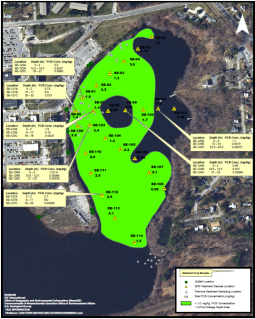
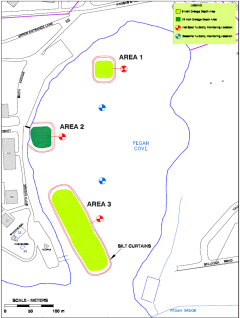
Figure 1. The Pegan Cove site with (a) the green area showing the area where PCBs exceeded 1 ppm and (b) the three hot- spots that were removed by hydraulic dredging to complete the remediationThe act or process of abating, cleaning up, containing, or removing a substance (usually hazardous or infectious) from an environment.. A fish advisory that is already in effect will continue.
A.54.5 Monitoring
Silt curtains placed separately around each of four hotspots. Two silt curtains installed around perimeter of each sediment hot spot. First (or interior) silt curtain acts as primary containment, while second (or exterior) silt curtain installed right behind first acts as secondary containment. Water monitoring done consistently outside silt curtains and sample readings never exceeded action threshold. Double silt curtains worked well at this site.
Average PCB concentration after dredging were less than 1 ppm. Four dredged areas were backfilled with clean sand, which lowered postdredging concentration from 1.03 to 0.97 ppm PCBs.
There is no long-term monitoring associated with this alternative because "No Further Action" status was granted after the cleanup met the proposed SWAC goal.
RAOs/project objectives achieved? The RAOs for this site were met.
A.54.6 References
PCB Contaminated Sediment Remediation in Waukegan Harbor. http://www.ijc.org/php/publications/html/cases/waukegan/waukegan.html.
Kevin J. Palaia, S. Reichenbacher, J. Connolly. Superfund Sediment PCB Cleanup Using Green & Sustainable Remediation Practices at the U.S. Army Natick Soldier Systems Center. http://www.epa.gov/region1/superfund/sites/naticklab/536503.pdf (ICF,2011).
USEPA Superfund Record of Decision: Natick Laboratory Army Research, Development, and Engineering Center EPA ID: MA1210020631. Sep 2001. http://www.epa.gov/superfund/sites/rods/fulltext/r0101547.pdf .
ICF International. First Five-Year Review Report for U.S. Army Soldier Systems Center (SSC) Town of Natick. SDMS 266254. Jan 2007. http://www.epa.gov/region1/superfund/sites/naticklab/266254.pdf.
Final Second Five-Year Review Report (2007-2011) for the Natick Soldier Systems Center. SDMS DocID 508767. March 2012. http://www.epa.gov/region1/superfund/sites/naticklab/508767.pdf.
Publication Date: August 2014